


New Private Limited Company Registration in India @ ₹999
- Expert assistance with filing completed in just 2 days for your growing business, T&C apply.
- Affordable and transparent pricing starting at ₹999 + government fees, with no hidden charges.
- End-to-end compliance management, including post-incorporation and banking support.

The Right Plan for Your Business
Guaranteed application submission within 7 days — or get a 100% money-back guarantee!
Starter Plan
Perfect for submitting your company application with expert assistance in 21 days.Enter your description-
Your company name filed within 4–7 days
-
DSC for 2 directors within 7–10 days
-
SPICe+ form filing completed within 21 days
-
Certificate of Incorporation issued within 40 days
-
Company PAN & TAN
-
DIN for directors
-
-
-
Standard Plan
Expert-assisted company registration completed within 14–21 days.+ Govt. Fee
-
Expert-assisted registration process
-
Company name filing completed within 2–3 days
-
DSC for 2 directors within 3–4 days
-
SPICe+ form filing completed within 10 days
-
Certificate of Incorporation issued within 14–21 days
-
DIN for directors
-
-
-
Pro Plan
Company registration + Trademark filing completed within 8–14 days.+ Govt. Fee
-
Expert-assisted registration process
-
Company name filed within 0–1 day
-
DSC for 2 directors within 1–2 days
-
SPICe+ form filing completed within 5 days
-
Certificate of Incorporation issued within 8–14 days
-
Company PAN & TAN
-
DIN for directors
-
Quick Trademark filing completed in 1 day
-
Free MSME registration
Note: Approval is subject to MCA review. We will make every effort to ensure smooth processing. T&C apply.
Overview
Private limited company registration in India offers limited liability, legal independence, and access to various tax benefits. Governed by the Companies Act, 2013, the process requires a DSC, DIN, and documents such as identity and address proof. The SPICe+ form allows a combined application for name approval, incorporation, PAN, TAN, and GST. Once approved by the RoC, you receive a Certificate of Incorporation, enabling the company to operate legally, own assets, and enter into contracts. Post-registration, compliance requirements such as annual returns and financial reporting must be fulfilled.
FilingIndia simplifies the entire registration process by providing end-to-end support for private limited company incorporation, legal documentation, and regulatory compliance. Our expert team ensures every step is handled efficiently and accurately, while maintaining complete transparency in pricing with no hidden charges.
What is a Private Limited Company (Pvt Ltd)?
A private limited company (Pvt Ltd) is a separate legal entity registered under the Companies Act, 2013. It provides limited liability protection to its shareholders, restricts the transfer of shares, and requires a registered office address. This structure is ideal for startups and SMEs looking for credibility, easier access to funding, and retained control over their business.

Companies Act, 2013
According to Section 2(68) of the Companies Act, 2013, a private limited company is a company with a minimum paid-up share capital as prescribed, and which, by its Articles of Association:
- Restricts the transfer of its shares;
- Limits the number of members to 200 (excluding current and former employees); and
- Prohibits any public invitation to subscribe to the company’s securities.
Types of Private Limited Companies (Pvt. Ltd.)
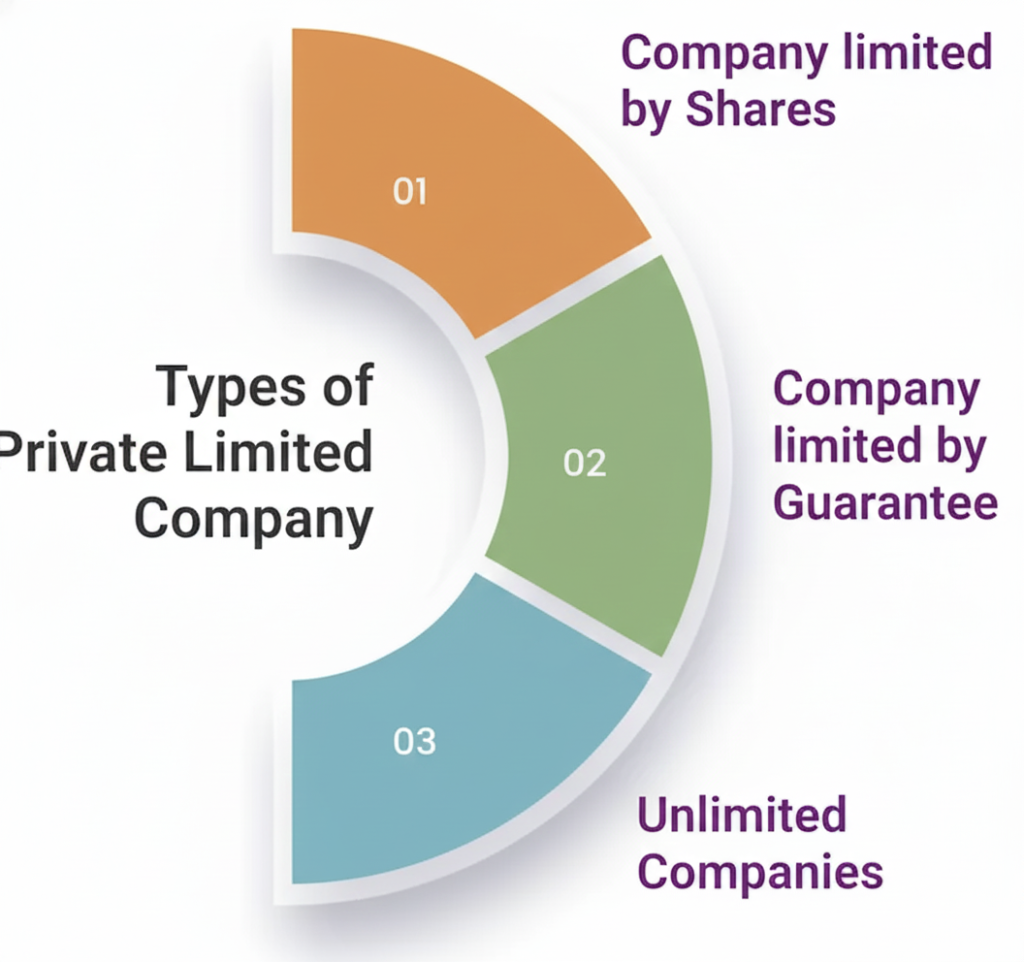
Choosing the right type of private limited company is crucial for legal protection, financial planning, and operational flexibility. In India, private companies are classified based on member liability and capital structure. The three main types are:
1. Company Limited by Shares
This is the most common type of private limited company. Here, the liability of shareholders is limited to the unpaid amount on their subscribed shares. This structure protects personal assets while allowing ownership through equity. It is ideal for businesses seeking investment from private investors or co-founders without risking personal finances.
2. Company Limited by Guarantee
Companies limited by guarantee do not have share capital. Instead, members agree to contribute a fixed amount in case of the company’s liquidation. This structure is best suited for non-profits, foundations, and social enterprises that require legal recognition without profit distribution. Members’ liability is limited to the amount they guarantee.
3. Unlimited Companies
In an unlimited company, members have unlimited liability, meaning they are personally responsible for the company’s debts or losses. This structure is rarely used but may be suitable for closely held entities where members are comfortable with full liability and desire maximum control.
Requirements for Private Limited Company Registration
To register a private limited company in India, certain legal and procedural requirements under the Companies Act, 2013 must be fulfilled. Meeting these conditions ensures valid incorporation and smooth post-registration operations.
1. Minimum Two Directors
A private limited company must have at least two directors. At least one director must be a resident of India, defined as someone who has stayed in the country for 182 days or more during the financial year.
2. Minimum Two Shareholders
The company must have a minimum of two shareholders. Directors and shareholders can be the same individuals. Both individuals and corporate entities are eligible to be shareholders.
3. Registered Office Address
A valid Indian address is required as the company’s registered office. Proof of address and a No Objection Certificate (NOC) from the property owner must be submitted.
4. Digital Signature Certificate (DSC)
All proposed directors must possess a Digital Signature Certificate (DSC) to digitally sign the incorporation documents.
5. Director Identification Number (DIN)
Each director must obtain a DIN, a unique identification number issued by the Ministry of Corporate Affairs.
6. Company Name
The company must have a unique name that is not identical or similar to existing companies or trademarks. This requirement must be fulfilled before filing the SPICe+ form for incorporation.
Meeting these requirements is essential before filing the SPICe+ form to register private limited company.
How to Register a Private Limited Company in India
Here’s a step-by-step process to register a private limited company under the Companies Act, 2013, regulated by the Ministry of Corporate Affairs (MCA):
-
Step 1: Obtain Digital Signature Certificate (DSC)
All proposed directors must acquire a valid Digital Signature Certificate (DSC) to sign electronic documents securely.
-
Step 2: Apply for Director Identification Number (DIN)
Each director must obtain a Director Identification Number (DIN), which is mandatory for company registration.
-
Step 3: Name Approval through SPICe+ Part A
Select a unique company name and submit it via SPICe+ Part A for approval by the MCA.
-
Step 4: Prepare Incorporation Documents
Collect all necessary documents, including identity proof, address proof, and proof of the registered office (such as a rent agreement or utility bill).
-
Step 5: File SPICe+ Part B, AGILE-PRO, eMOA, and eAOA
Complete the incorporation by filing SPICe+ Part B along with linked forms, including details of authorized capital, company objectives, and internal rules.
-
Step 6: PAN, TAN & GST Application
Through the online registration, obtain the company’s PAN and TAN, and optionally apply for GST registration.
-
Step 7: Verification by RoC & Certificate of Incorporation
After review and approval by the Registrar of Companies (RoC), a Certificate of Incorporation is issued, along with the company’s Corporate Identification Number (CIN).
-
Step 8: Post-Registration Compliance
After incorporation, complete key post-registration tasks, including opening a bank account, issuing shares, maintaining financial statements, and ensuring ongoing legal compliance.
Documents Required for Private Limited Company Registration in India
The documents required for registering a Private Limited Company in India are used to verify the identity, address, and legal authority of the directors and shareholders. These requirements are prescribed by the Ministry of Corporate Affairs (MCA) under the Companies Act.
For Indian Nationals
Identity Proof (any one):
PAN Card (mandatory)
Passport
Aadhaar Card
Voter ID
Driving Licence
Address Proof (any one):
Recent utility bill
Bank statement (Must not be older than 2 months)
For Indian Nationals
Identity Proof :
Passport (Mandatory)
Address Proof (any one):
Residence card
Bank statement
Driving Licence
For Corporate Shareholders
Board Resolution: A duly signed resolution authorizing investment in the proposed company
Certificate of Incorporation: Legal proof of registration of the investing entity
Registered Office Address Proof
Rent Agreement or NOC: Lease agreement along with a No Objection Certificate (NOC) from the property owner
Utility Bill: Recent electricity bill or property tax receipt (not older than 30 days)
Constitutional Documents
Memorandum of Association (MoA): Defines the company’s objectives and scope of business
Articles of Association (AoA): Specifies the internal rules and management structure of the company
Statutory Declarations and Registrations
Declaration and Consent Forms: Includes Form INC-9 and Form DIR-2, confirming statutory compliance and director consent
Digital Signature Certificate (DSC): Mandatory for all proposed directors for online filings
Director Identification Number (DIN): A unique identification number required for each director
Common Requirements for All Applicants
Photographs: Recent passport-size photographs of all directors and shareholders
Timeline for Private Limited Company Registration in India
The registration of a Private Limited Company in India generally takes 10 to 15 working days, depending on factors such as name availability, accuracy of documents, and processing time at the Ministry of Corporate Affairs (MCA). Below is a step-by-step overview of the Private Limited Company registration process:
Registration Process Timeline
-
Name Approval (3–4 working days):
Apply for and reserve the proposed company name through the MCA portal.
-
Director Identification Number (DIN) (up to 3 working days):
Obtain a DIN for all proposed directors, which is mandatory for incorporation.
-
Digital Signature Certificate (DSC) (1–2 working days):
Procure a DSC for each director to enable electronic filing of documents.
-
Drafting of MOA & AOA (2–3 working days):
Prepare the Memorandum of Association (MOA) and Articles of Association (AOA), outlining the company’s objectives and governance structure.
-
Filing Incorporation Documents (5–7 working days):
Submit the SPICe+ incorporation forms along with all supporting documents to the MCA.
-
Issuance of Certificate of Incorporation (2–3 working days):
Once approved, the Registrar of Companies (RoC) issues the Certificate of Incorporation, officially registering the company.
Important Note:
Each stage of the process is essential. Delays may occur due to incomplete or incorrect documentation, name rejection, or processing backlogs at government offices.
Benefits of Private Limited Company Registration
A Private Limited Company (Pvt. Ltd.) offers several advantages, making it a preferred business structure for entrepreneurs and startups in India.
Limited Liability
Shareholders’ liability is limited to the amount invested in the company, ensuring that personal assets remain protected.
Separate Legal Entity
The company has a distinct legal identity, separate from its owners. It can own property, enter into contracts, and initiate or defend legal proceedings in its own name.
Easier Access to Capital
Private Limited Companies can raise funds through equity, loans, and venture capital, making it easier to attract investors and financial institutions.
Tax Advantages
Eligible companies may benefit from lower corporate tax rates and deductions on allowable business expenses such as salaries, rent, and utility costs.
Enhanced Professional Credibility
Company registration enhances credibility and helps build trust with customers, partners, vendors, and investors.
Perpetual Succession
The company continues to exist regardless of changes in ownership, directors, or shareholders, ensuring long-term business continuity.
Easy Transfer of Shares
Shares can be transferred with the approval of shareholders, allowing flexibility in ownership without affecting day-to-day business operations.
Difference Between Private Limited Company and Other Business Structures
A Private Limited Company is one of the most preferred business structures in India, owing to its separate legal identity, limited liability protection, and formal registration process under the Companies Act, 2013, as regulated by the Ministry of Corporate Affairs (MCA).
| Criteria | Private Limited Company (PVT) | One Person Company (OPC) | Limited Liability Partnership (LLP) | Sole Proprietorship |
|---|---|---|---|---|
| Legal Status | Separate legal entity | Separate legal entity | Separate legal entity | Not a separate legal entity |
| Liability | Limited to shareholding | Limited | Limited | Unlimited liability |
| Number of Members | 2–200 members | 1 person only | Minimum 2 partners | 1 owner |
| Compliance Requirements | High (ROC filings, financial statements, DIN, DSC) | Moderate | Moderate | Minimal |
| Tax Benefits | Eligible for deductions and incentives | Similar to Pvt Ltd | Some benefits applicable | Taxed as personal income |
| Funding Scope | Easy to raise from financial institutions and investors | Limited | Difficult | Not preferred by investors |
| Company Incorporation | Through SPICe+ with DSC, DIN, registered office address proof | Similar process | Different process under LLP Act | No registration required |
| Registration Authority | Registrar of Companies (RoC) | RoC | RoC | No formal authority |
| Compliance Cost | Moderate to High (professional fees, government fees) | Moderate | Moderate | Low |
This table helps entrepreneurs compare and select the most suitable business structure for company registration in India, based on their business goals, compliance requirements, and liability protection needs.
Mandatory MCA Compliance for Private Limited Companies
This table helps entrepreneurs compare and select the most suitable business structure for company registration in India, based on their business goals, compliance requirements, and liability protection needs.
| Aspect | Compliance Requirement | Frequency | Importance |
|---|---|---|---|
| Annual Return Filing | File Form MGT-7 with details of shareholders, directors, and company structure | Annually (within 60 days of AGM) | Updates MCA records and ensures transparency in the company’s ownership and management |
| Financial Statements | File Form AOC-4 containing balance sheet, profit & loss account, and audit report | Annually (within 30 days of AGM) | Discloses the company’s financial position and helps maintain its active registration status |
| Board Meetings | Conduct a minimum of four board meetings with a maximum gap of 120 days | Quarterly | Ensures effective corporate governance and supports strategic decision-making |
| Annual General Meeting (AGM) | Hold AGM to review financial statements and appoint or reappoint auditors | Annually (on or before 30th September) | Mandatory under the Companies Act for all registered companies |
| Director KYC | File Form DIR-3 KYC for verification of Director Identification Number (DIN) | Annually | Ensures accurate director information is maintained with the MCA |
| Income Tax Filing | File Income Tax Return using Form ITR-6 | Annually | Ensures compliance with Indian income tax laws |
| Statutory Audit | Get accounts audited by a Chartered Accountant | Annually | Verifies financial accuracy and improves credibility with banks and investors |
| TDS Filing | File quarterly TDS returns as applicable | Quarterly | Ensures tax compliance and helps avoid interest and penalties |
| Compliance Certificate | Obtain compliance certificate from a Company Secretary (if applicable) | Annually | Mandatory for companies with paid-up capital exceeding ₹10 crore or turnover above ₹50 crore |
| Commencement of Business | File Form INC-20A after incorporation | Within 180 days of incorporation | Confirms commencement of business operations and is legally mandatory |
| DIN Updates | Maintain updated DIN details for all directors | Ongoing | Required for any changes involving resident or foreign directors |
| GST Registration | Apply for GST registration if applicable | One-time (Post Incorporation) | Enables lawful tax invoicing and compliant business transactions |
Why Choose FilingIndia for Private Limited Company Registration?
Registering a Private Limited Company is a crucial step toward establishing and growing your business in India. FilingIndia offers reliable, end-to-end support to make the process smooth and stress-free.
1. End-to-End Incorporation Support
From SPICe+ form preparation to final approval from the Ministry of Corporate Affairs (MCA), FilingIndia manages the entire registration process, ensuring fast, seamless, and hassle-free incorporation
2. Company Name Selection & Address Proof Assistance
We help you choose a unique, MCA-compliant company name and guide you in preparing valid registered office documents, including rent agreements, utility bills, or ownership proofs.
3. Conversion from One Person Company to Private Limited Company
If you are currently operating as a One Person Company (OPC), we assist you in transitioning to a Private Limited Company—an ideal structure for business expansion and attracting investors.
4. Bank Account Setup & Capital Advisory
After incorporation, we support you in opening a business bank account and provide expert advice on authorized and paid-up capital requirements based on your business objectives.
5. Digital Certificate of Incorporation & Foreign National Support
Receive your Certificate of Incorporation digitally along with PAN and TAN. We also provide specialized assistance for foreign nationals, ensuring compliance with all regulatory and documentation requirements.

Start and grow your business in India with FilingIndia’s expert support.